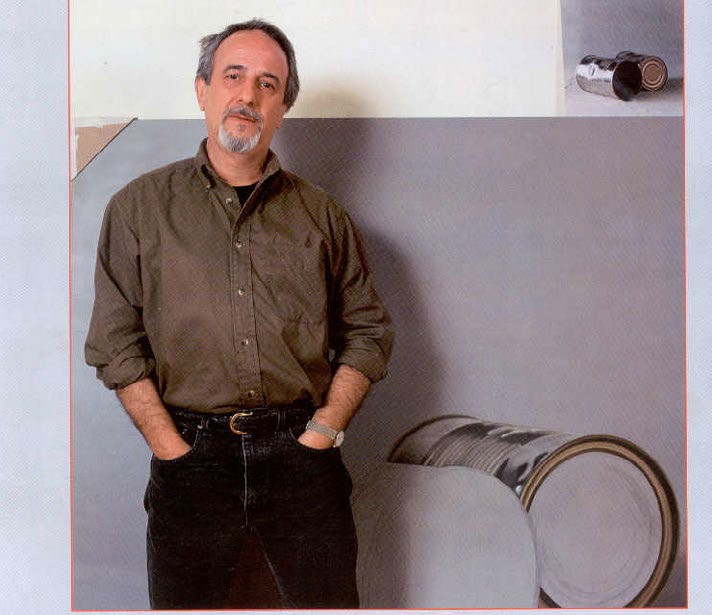
Proportion is defined as the relationship, in magnitude, quantity, or degree, of one thing to another, or of a part to the whole. Scale relates the dimensions of different objects, or of object and subject. In the paintings of Hugo Laurencena (Argentina, 1950), the scale of everyday objects pushes past the limits of the imaginary. His oils capture the viewer’s attention, drawing out details in common, ordinary things. Laurencena began painting in the 1970s within the hyperrealist movement. Answering that era’s needs of expression, his early oils rendered reality as an exact, cold, impersonal photographic likeness — one that ultimately spoke to the futility and desperation of urban life.
Still shaped by that movement but no longer calling himself a hyperrealist, Hugo reflected on his canvases — always linen — his own appreciation for what, to many of us, goes unnoticed. Perhaps we should ask ourselves whether we are living at such an accelerated pace that we no longer have time to contemplate the things that make up our everyday surroundings: a shoe, a length of rope, even three bottles wrapped in paper. Laurencena photographed the object, stripping it of context.
“I don’t represent things with an intention to imitate, but by sliding toward a representation of the inner nature of things.”
His early training passed through the world of advertising; he later worked in the studios of various painters. “That’s how ideas get to move around, and the view can open up instead of staying partial.” When he became an assistant to the celebrated painter Willem de Kooning in New York, he immersed himself in abstract expressionist technique — wrapped up in pigment, in color. Moving between studios, he refined a technique built on layers of oil, transparency, and the interplay of light and shadow, not unlike that of the Flemish school.
His paintings invite a passage through a metaphysics of the everyday, approaching the very essence of the matter that makes up objects. Laurencena’s work expresses tension between reality and virtuality, between a luminous space and the gloom of certain areas, between the reflected spirit of what is on display and the solitude in which it is placed. After taking in his canvases and this sharp perception of things, one’s view of the everyday is unlikely to be quite the same again.