Plato, in The Republic, condemns art as simulacrum — “that supreme danger, that poison which, by mixing all things together, passes the philosopher off as a sophist, truth off as illusion, deceiving all those who lack the antidote of reason and knowledge: animals, children, and the ignorant.”
When, toward the end of the twentieth century, a new Prometheus defies the gods of Olympus by stealing the sacred fire of creation — to fashion, himself, men in the image and likeness of the immortals — he no longer receives the punishments of the chained hero.
Laurencena proposes in his paintings an insolent, ambiguous presence that is also the sign of an absence; he generates multiple circulations around empty space, from the “shopping bags” he painted in 1991 to today’s shoes, from banal containers to unsettling, disturbing contents. The old wooden shoe-lasts appear, giving birth to an enigmatic phenomenon of near-virtual reality.
In the artist’s poetics, the lasts occupy the place of the unrepresentable; the authentic work of art slides along a double register, oscillating between representation and the unrepresentable, summoning the encounter with the originary emptiness that resides at the heart of every object.
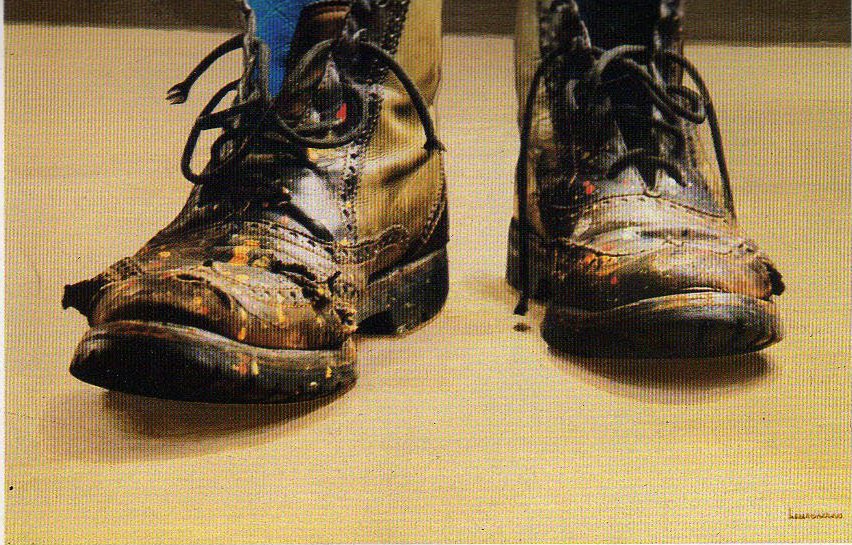
With severe rigor and an obsessive pursuit of perfection, the artist paints shoes at an increased scale, decontextualized, creating for them a splendid isolation. Elevated to the category of human-objects, the women’s shoes suggest a high-voltage eroticism, while those the artist used to work send us back to a modest self-portrait.
Laurencena is not afraid of perfection; he plays with it poetically because he knows he will never attain it. That is how he keeps the drive alive — the desire to keep desiring.
In the end, the painter’s own work becomes an almost anecdotal detail; the process of creation, the metaphor, precedes the virtuoso realization of the painting, which no longer generates fleeting enjoyment, but perpetuates a distanced, silent, sublimated pleasure.