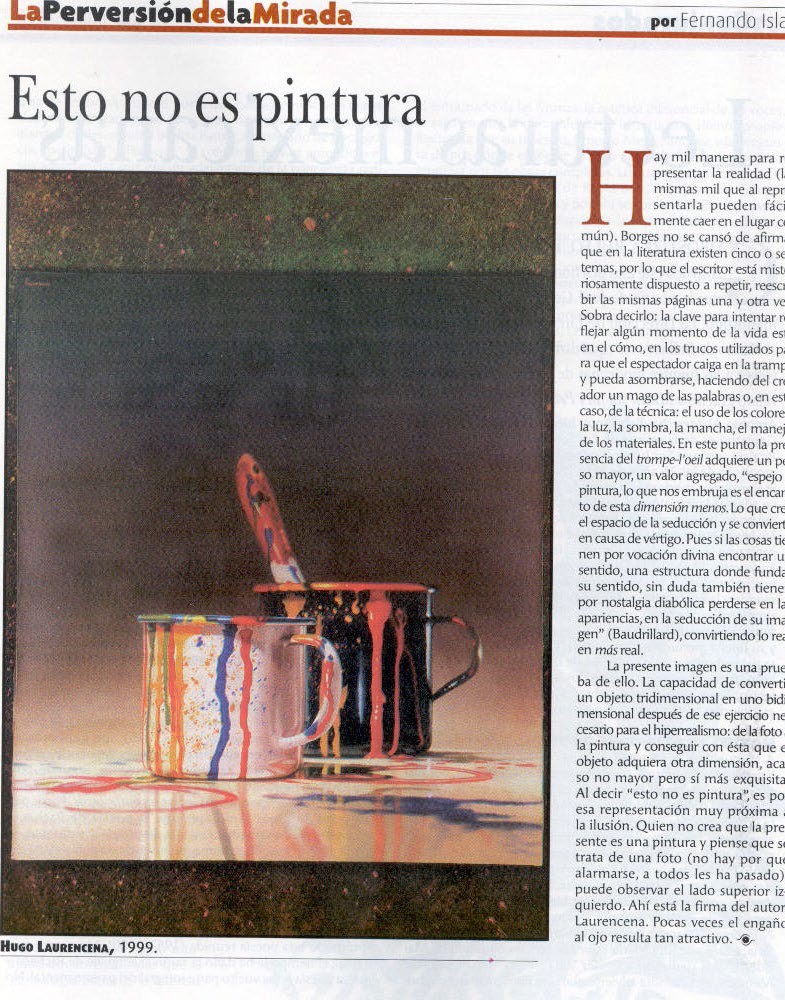
There are a thousand ways to represent reality — and the same thousand ways in which representing it can easily fall into cliché. Borges never tired of claiming that there are only five or six themes in literature, so that the writer is mysteriously bound to repeat, to rewrite the same pages again and again. The key to reflecting some moment of life lies in the how: in the tricks used so the viewer falls into the trap and can be amazed, making the creator a magician of technique — the use of color, light, shadow, stain, the handling of materials. On this point the presence of the trompe-l’oeil acquires added weight, an added value: what bewitches us is the enchantment of this lesser dimension. What we believe to be the space of seduction becomes, instead, a cause for vertigo.
This image is proof of that. The capacity to convert a three-dimensional object into a two-dimensional one — the exercise necessary for hyperrealism: taking the photo, painting it, and achieving an object that acquires another dimension, not a greater one, but a more exquisite one. To say “this is not painting” is possible because of a representation so close to illusion. Whoever doesn’t believe what is present is a painting, and thinks instead that it’s a photograph, can look at the upper left corner. There is the artist’s signature: Laurencena. Rarely does a trick of the eye prove so attractive.