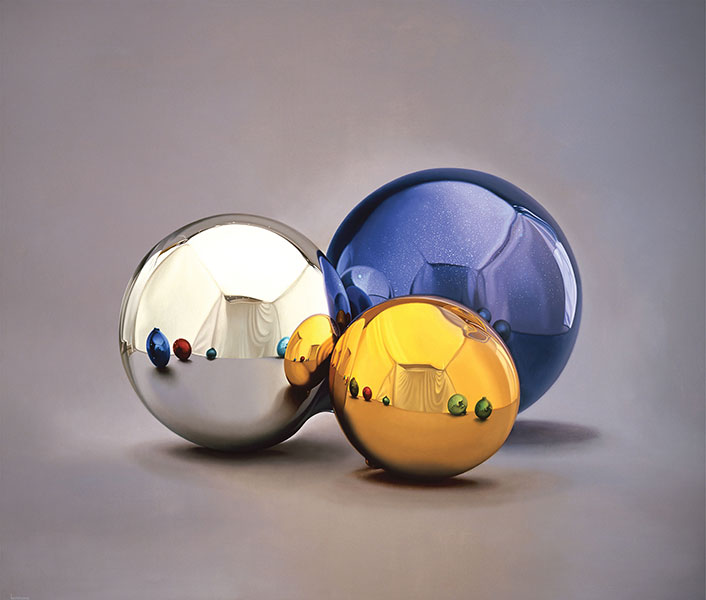
There is a kind of latent obligation with Laurencena: the obligation to see. When we look closely at one of his paintings — close enough to see a tiny brushstroke within a larger shape — our gaze almost goes crazy. In turn, if we step back and retract that first, necessary impulse to verify, our gaze is filled with a perfect shape. Sometimes gleaming, sometimes duller: it is the shadow play that comes to life on an object in an empty space. Because Laurencena also makes us see the emptiness. And in this emptiness, there comes a point when something explodes without too much noise, and seems stratospherically accelerated in a single movement. Then something appears, and the emptiness stands aside to watch it. As we all know, in order to see, you have to establish a distance — because of the circles of confusion that physicists have studied, and their effects. They know that when you look too closely, your gaze is lost in hundreds of tiny circles made by light as it bounces off an object. If you are very close for a long time, you become confused and the figure becomes blurred — it melts into the oil paint among the elusive traces of what was once a brushstroke. After looking this closely for a while, the gaze ends up seeing itself, reflecting the circles of light bouncing off the objects, over the painted reflections. Let it be that moment when we are actually seeing.
If another sense were to come into the equation at that point when the gaze is suspended, marveling in itself… if, for instance, the sense of touch were then to ask for some sort of proof, our body would step back once again. It would jump back to the place of no-contact, and would not be able to leave it: everything to maintain the illusion; the illusion of beautiful things. People who know understand that you do not touch beautiful things — you only look at them, silently.
That is why it is all about distances. Objects and the gaze: they each demand and maintain their own distance. Even when we believe Laurencena’s is a game playing with dimensions, even when we suppose we are seeing the details of the pearl because of its increased spherical size, we would be mistaken if we thought it was an issue of size. We do not see what we see because it is bigger, but because it is closer. And there is so much detail that the body requires a certain position to be able to absorb it all, in steps, in layers, like those of the oil paint. Distance is like that: it deals with layers, and the gaze can only absorb its journey in the pauses between its slow, careful advances. After all, distance has much more to do with time than with space.
When the gaze travels over a certain distance, it faces atmospheres and consistencies. Something quite similar happens when the gaze dwells on Laurencena’s closely rendered objects. This is why the curves, like total continuities that make the shapes endless, ground each object in a non-place that they apparently share — a non-place that, at a single glance, makes you feel like you are condemned to be the eternal spectator. Painted illusions whose perfection eliminates the possibility of belonging. It is no longer your gaze that creates this revealed world, but the awareness of the perfect outline of Laurencena’s objects.
Photography as a medium for painting could be thought of as reductive when looking at Laurencena’s paintings — a manual copy of a mechanical rendering. However, when facing his work, it might be more appropriate to ask: is it not the painting here that is a medium for photography? Could the recurrent victory of the brush over the photographic form, in a constant, stubborn battle, be a victory not against the painter’s own possible achievements, but against the machine itself? If so, the victory is bound by time, which ends up turning “its photographs” into objects in and of themselves — the time of execution, indeed, but more importantly the obligatory time of looking. Time to turn what was once a mere reproduction into something autonomous.