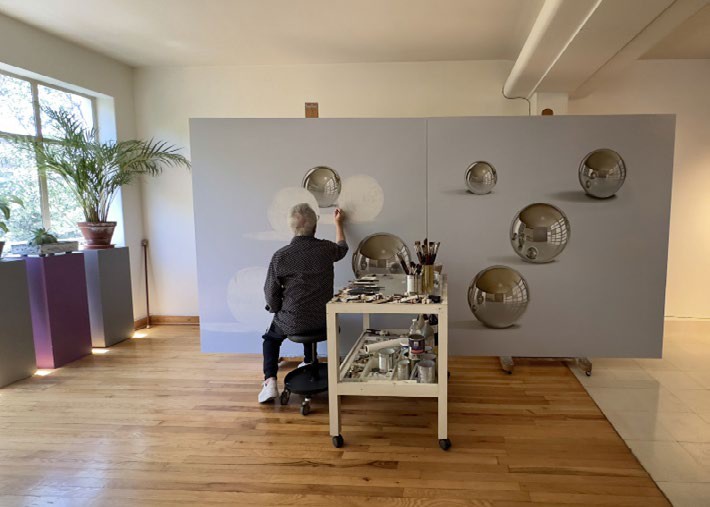
When Marguerite Yourcenar’s editor pressed her to give her memoirs a title, she settled on something fairly conceptual and poetic: What? Eternity — a title that could just as easily belong to the Argentine artist Hugo Laurencena (Buenos Aires, 1950), if only the temporal reference were swapped for something more concrete: the real, what we see here and now. Laurencena, who began his career as creative director at McCann Erickson, inverted the usual path of the artist — from the real to fiction, from the lived to the imagined — and refined his style, moving from an early surrealism to a hyperrealism that broke down the boundaries between the real and the unreal, the imagined and the lived.
“At first I painted objects in surreal situations, nothing like the hyperrealism I started doing afterward. I got hooked on this North American hyperrealist current, made from a photograph — one I take myself — and then transferred to oil. My work is actually realism, not hyperrealism, because I take the object out of its natural habitat and bring it into a metaphysical situation,” he explained. While hyperrealism tends to be more of a copy of a photograph, he preferred to paint a very specific reality: his own. “I started by cleaning up the object, gradually abstracting it from its surroundings, until it became more realism than surrealism,” he added.
Laurencena lived in different cities and countries: more than 20 years in New York, and after a short stint in Miami, he settled in Mexico City, where he lived and worked for 23 years. His work was genuinely fascinating for its focus on the representation of objects. Through his meticulous eye, he decontextualized them and portrayed them in neutral, timeless spaces, turning them into something close to everyday icons.
The artist achieved significant recognition in the art world, with exhibitions and shows in prestigious museums and galleries across Mexico, Argentina, the United States, Switzerland, Italy, Brazil, and Chile. In his later years, he explored different means of limited artistic reproduction, such as giclée prints and manipulated photography, and experimented with smaller formats — bringing a new dynamic to his work and helping bring it to a wider audience. But in any case, what mattered most was the artist’s gaze, turning the real into a totem.